Breguet’s 220th Anniversary of the Tourbillon, Classique Tourbillon Extra-Plat Anniversaire 5365
By breguet blog • december 31, 2021
ABRAHAM-LOUIS BREGUET was granted the patent to the tourbillon regulator on 26th June 1801, or according to the French Republican calendar in use at the time, 7 Messidor An IX.
Tourbillon translates as ‘whirlwind’ in English and Breguet was known to have worked on the Régulateur à Tourbillon around 1795.[1] This novel mechanism was designed to compensate for the effect of gravity on the balance of a pocket watch that was worn or carried vertically. It is a revolving carriage supporting the escapement of a watch that rotates completely on its axis continuously through 360 degrees negating the effects of poising errors (see glossary, Tourbillon).
Breguet initially produced two prototypes, watch no. 169, which he finished for John Arnold and later gave to his son John Roger in memory of his father, Europe’s leading clock and watchmaker, in 1809, and watch no. 282 which was completed in 1800 but sold much later by Breguet’s own son, Antoine-Louis.[2] Breguet put up his first tourbillon for sale in 1805 and the following year exhibited at the Exposition nationale des produits de l’industrie on the Esplanade des Invalides, Paris.
Breguet summarised his invention in the 1801 patent as a “watch compensating for all disparities that may be found in the balance and balance spring.” As the mechanism was extremely difficult to put into practice, only thirty-five tourbillon timepieces were made and sold between 1805 and 1823, the year of Breguet’s passing.
One of the most impressive surviving examples from Breguet’s own bench is the aforementioned Régulateur à Tourbillon no. 1176, illustrated below. The gold pocket chronometer with tourbillon, was sold through Monsieur Moreau at St. Petersburg, Russia, on 12th February 1809 to Count Stanislas Potocki (1755-1821) for 4,600 francs.
As well as Breguet’s overall craft, the watch is of such scholarly and historic importance in the evolution of the tourbillon, that it is worth examining in detail. Figs. 1-4 show the front, side, works and back of watch no. 1176 with accompanying explanations underneath each.
.jpg)
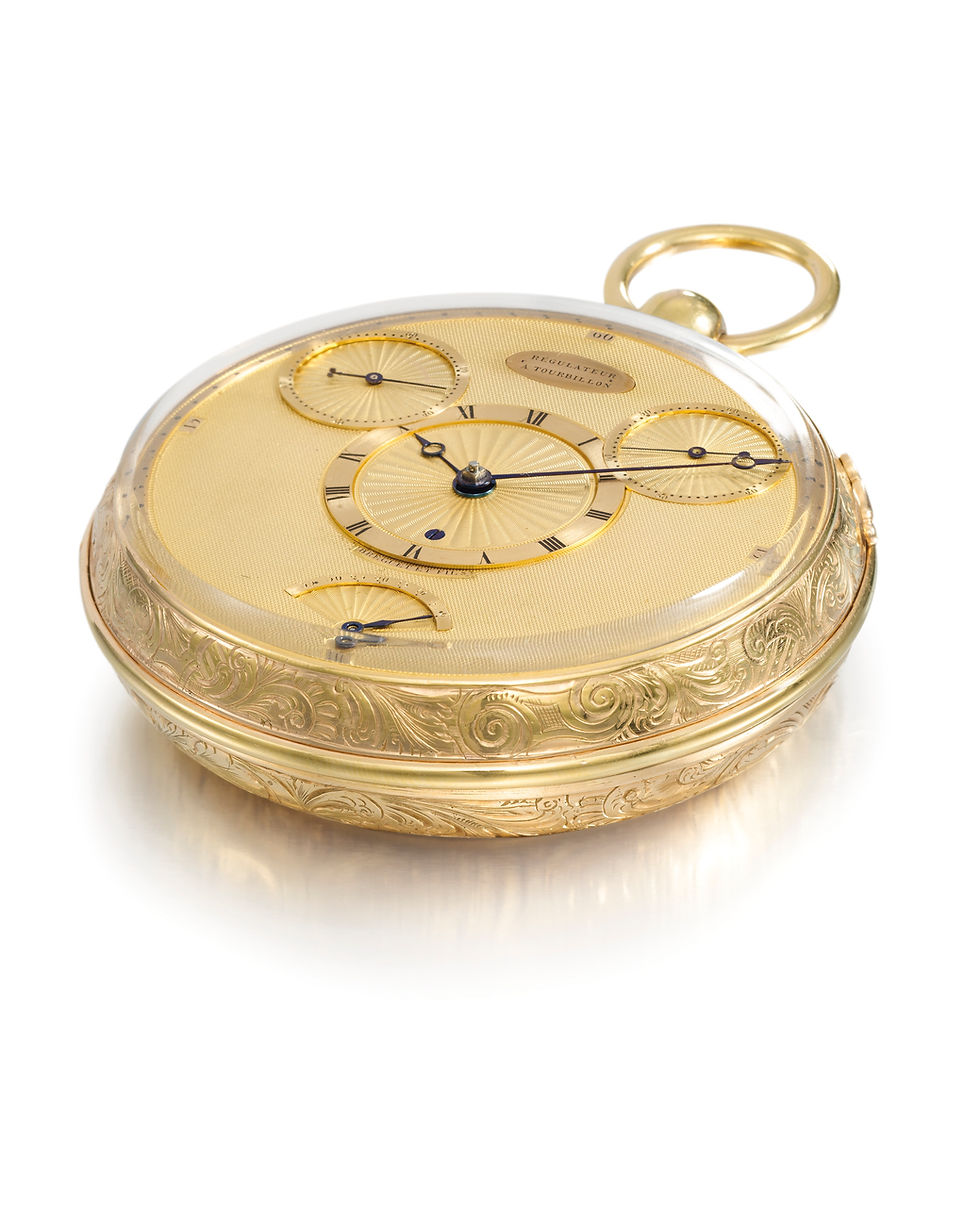
fig. 1 Breguet No. 1176 Montre garde-temps à tourbillon; gold engine-turned dial by Tavernier, featuring hobnail clou de Paris guilloche on the main dial and a solar guilloche pattern across all four subsidiary dials; sweep centre minute hand and small concentric chapter ring for the hours (Roman numerals); outer chapter ring showing dot minute and Arabic 15-minute increments for high legibility; two subsidiary dials above for running seconds (left) and seconds on demand (right), activated by means of the floral-shaped lever on the side of the case at two o’clock to stop and restart the seconds hand; 35-hour power reserve at six o’clock; signed Breguet et Fils, the gold plaque above engraved Régulateur à Tourbillon; blued-steel Breguet hands; held in an engraved gold case. Photo © Christies
.jpg)
fig. 2 Side view showing the domed rock crystal, raised chapter rings and power reserve countdown; 18-ct., four body, gold case with hidden hinges by Amy Gros (no. 1282), later engraved with floral scrollwork. Photo © Christies
.jpg)
fig. 3 Four-minute tourbillon with échappement naturel escapement; two-armed compensation balance; gilt metal 24-lignes half-plate movement with reversed fusée and chain; signed Breguet; 65.5 mm. diameter (2½ in approx.). Photo © Christies
.jpg)
fig. 4 The pocket watch exhibits masterful hand engraving, decorated in scroll and foliage across the bezel and rim; the engraved back shows the Piława coat of arms of the
House of Potocki. Photo © Christies
The pocket watch was Breguet’s third tourbillon, having been preceded by the first, no. 282 (1800) and second, no. 169 (1809).
Watch no. 1176 also represents Breguet’s first four-minute tourbillon watch which beats at 3 Hz (21,600 vph), an impressively high rate at a time when most watches had a rate of 2-2.5 Hz (14-18,000 vph).
A small tribute to the watch’s original owner would not seem out of place at this point: Count Stanislas Potocki was a nobleman, politician, writer, collector and one of the pillars of the Age of Enlightenment in Poland.
Born in 1755 in Lubin, Potocki was educated at the Warsaw Collegium Nobilium and went on to study literature and the arts in Wilanów. He married Aleksandra, Princess Lubomirski, on 2nd June 1776 and pursued a mainly political career. Potocki further became Grand Master of the Polish Freemasons in 1784 and latterly rose to become Artillery General of the Crown in 1792. He took part in the war against Russia in defence of the Constitution of 3rd May 1791 and left Poland soon after its dismemberment. Potocki was arrested at Carlsbad at the uprising of Kosciuszko and spent eight months in captivity in Josephstadt. He was released in 1795 and returned to his home country in 1797 and subsequently undertook a grand restoration of the Wilanów Palace, filling it with exquisite art including Etruscan vases, drawings, paintings, sculptures which opened to the public in 1805, making it one of the first museums in Poland.
On 25th March 1809 Potocki was nominated chairman of the Council of State and the Council of Ministers, a post he held until 1813. Potocki also oversaw educational authorities as head of the Department of National Education (1815) and then as Minister of the Commission of Religion and Public Education. Together with a priest, Stanisław Staszic, the two men provided the impetus for the creation of the University of Warsaw, founded by a decree issued on 19th November 1816 by Tsar Aleksander I. From 1818 to 1820 he was chairman of the Senate.
Potocki spent his remaining years at the Wilanów Palace and died on 14th September 1821. He was ceremoniously laid to rest in the mausoleum. He left behind his wife and one son, Aleksander Stanisław (1776-1845).

fig. 5 Portrait of Count Stanislas Potocki by Jacques-Louis David (1781). Museum of King Jan III’s Palace at Wilanów, Warsaw. Fair use
Entrer Anniversaire!
In 2022, to mark the 220th anniversary of the invention of the tourbillon by its founder, the House of Breguet pays tribute with a limited edition of 35 numbered timepieces in rose gold in the form of the Breguet Classique Tourbillon Extra-Plat Anniversaire 5365.

fig. 6 Breguet Classique Tourbillon Extra-Plat Anniversaire 5365 in rose gold and a rare early copy of Salomons’ Breguet. Photo © Breguet Blog
The Anniversaire joins the family of Classique Tourbillon Extra-Plat Automatique wristwatches which were first released in 2013. These fine, gentleman’s wristwatches pay homage to the vision of Abraham-Louis Breguet. The tourbillon is an essential part of Breguet’s watchmaking DNA and at the same time remains inseparable from the company’s aesthetic vision. No other watchmaker can claim a monopoly of such magnitude over the entirety of horology.
Like all members of the extra-thin, automatic tourbillon selection, the Anniversaire is elegantly proportioned and sized. The watch is 41mm in diameter and delightfully thin at 7.08mm. The coin-edging, or case band fluting, graces the case and crown, adding to the refinement of the watch. As with all models in this family the watch exhibits a sapphire case back which reveals an explosive view of the hand engraved movement, depicting the watercolour illustration Breguet submitted with his patent application for the tourbillon in 1801.
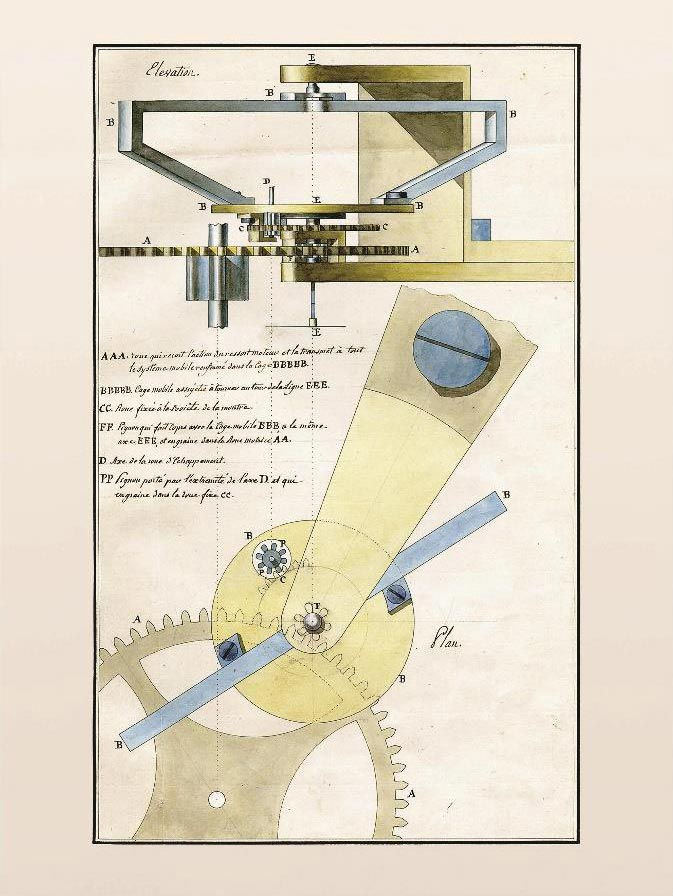
fig. 7 The watercolour illustration for the tourbillon patent, filed during the first part of 1801. The watercolour is kept in the archives of the Institut National de la Propriété Industrielle, Paris. Photo © Montres Breguet SA


fig. 8-9 Dial side and case back of the Anniversaire equipped with an ultra-thin leather strap with rose gold triple blade folding clasp. This watch oozes elegance. Photos © Breguet Blog
There are a number of details that set this watch apart from the rest in the extra-thin automatic tourbillon family. The dial of course heralds Breguet’s guilloche and a timeless, asymmetrical dial layout bearing Roman numerals. Herein the chapter ring and seconds ring for the tourbillon are raised adding a subtle three-dimensional touch to the dial. This effect is enhanced by two small cartouches, also raised, highlighting the name Breguet at twelve o’clock and the unique reference number for each watch which is replicated on the case back together with its limited-edition number from 1/35 to 35/35. A second, smaller cartouche is found again at the twelve o’clock position above the tourbillon bearing the inscription ‘Brevet Nº 157’ which refers to patent number that was granted to Abraham-Louis Breguet for his invention of the tourbillon.

fig. 10 Side view of the Anniversaire showing the raised chapter rings for the main dial and tourbillon; open-tipped Breguet hands in blued steel complimented by a blued steel tourbillon bridge; polished, screw-in welded lugs that remain unobtrusive and Breguet’s Empire-style case band fluting. Photo © Montres Breguet SA
Connoisseurs, in particular, should delight at the extra-thin 60-second tourbillon, located between 4 and 6 o’clock on the dial. One of the three axes of the tourbillon is finished to a point indicating the seconds. The tourbillon finishing is not only a delight but a masterpiece of polishing. Its wafer-thin construction can be seen through the front and back of the watch. Breguet’s engineers have once again effortlessly fused complexity with a weightless appearance that is breathtaking to look at. One does not need a loupe in order to appreciate the delicate thinness of this watch. One sideways glance at the case and tourbillon are sufficient to reassure even the most demanding buyer.
The real unique identifier that marks this watch, however, is the balance bridge across the tourbillon. It sports a straight brushed finish mimicking the chapter rings on the dial and is finished in blued steel complimenting the famous Breguet hands. In order to stay with the blue theme of the dial the balance bridge is set with a matching blue sapphire, rather than the traditional red ruby, over the centre of the tourbillon. The blued bridge adds a zestfulness to the dial and doubles as a new, never before seen, signature. It represents the first time Breguet have finished a balance bridge in this manner. True to form, its appearance remains discrete from all angles.

fig. 11 Side view of the tourbillon and bridge (insert), deftly proportioned in concert with the main dial. The silicon escape wheel, another breakthrough technological achievement by Breguet, is visible through the tourbillon between 12 and 3 o’clock.
Photo © Montres Breguet SA
The tribute to Breguet’s most famous patent is mirrored on the back of the watch. The patent number and grant date are engraved across the rear tourbillon bridge with another blue sapphire and the inscription: ‘Brevet Nº 157 Du 7 Messidor An 9’. This is flanked by the unique movement number, thirty-three jewels and the Swiss calibre 581. The word ‘Tourbillon’ is engraved upper left of the tourbillon and immediately above sits the mainspring barrel with a gorgeous sunray-brushed finish and the engraving ‘Anniversaire 1801-2021’. A sumptuous engraving of Breguet’s watercolour illustration adorns the two bridges on the right. Nine red rubies illuminate the bridges giving the movement a gentle, bejewelled look that is in perfect harmony with the aesthetic of the watch.

fig. 12 Case back detail of tourbillon and bridge highlighting the fine finishing
by Montres Breguet. Photo © Montres Breguet SA
One of the many highlights of this watch is the spectacular finishing to the bridges and movement. The chamfered bridges speak softness and there is a silkiness to the entire assembly that is exceptional. The anglage is heightened by the presence of mirror-polished screws which seem to float in a sea of polishing. The self-winding peripheral rotor in platinum offers a dynamic counterpoint to the kinesis of the tourbillon when viewed from the front. The rotor has been engine-turned with a wave motif and hand engraved with the name of the manufacture, rounding off the affair with great elan.

fig. 13 Case back of the Anniversaire showing its superb finishing and hand engraving by Breguet’s artisans. A minor but deft touch is the small indentation where the crown meets the case, allowing for easier access of the fingers. Photo © Montres Breguet SA

fig. 14 Dial side of the Anniversaire. Photo © Montres Breguet SA
From the front we can see one of Breguet’s classic features from afar: the hand-engraved dial in 18-carat silvered gold, on a rose engine in four parts, which is adorned with two different types of guilloche, clous de Paris (hobnail) and grain d’orge (barleycorn) around the periphery. Engine-turning is of course one of the hallmarks of Breguet and from a short distance the main dial takes on the appearance of a matt finish. The effect of clous de Paris is achieved with a diamond chisel resulting in engraved, interlaced lines with a pitch of only 0.25mm. This is sufficient to complete the look of the dial and has the added benefit of attracting tiny particles of dust, since the grain acts as a kind of carpet within the watch to shield the oils and mechanism from unnecessary wear and tear (see glossary, Perlage).
There is no doubt that the Anniversaire is a stunning achievement in Breguet’s series of extra-thin automatic tourbillons. All in all, there are now eight models that make up this family of watches:
-
Refs. 5377BR and 5377PT (2013) were presented with tourbillon at 5 o’clock and silvered dial and power reserve at 8:30;
-
Refs. 5367BR and 5367PT (2018) were presented with tourbillon at 5 o’clock and dials in Swiss Emaille Grand Feu enamel and hand-applied Breguet Arabic numerals;
-
Refs. 5395BR and 5395PT (2019) were presented with tourbillon at 5 o’clock and openworked or squelette movement;
-
Ref. 5367PT (2020) was presented with tourbillon at 5 o’clock, blue Grand Feu enamel dial and silvered, hand-applied Breguet Arabic numerals, hour and minute hands;
-
Lastly, in 2021, the Anniversaire is presented with tourbillon at 5 o’clock and blued steel tourbillon bridge in limited edition with a unique engraving of Breguet’s tourbillon patent on the back.
When first released in 2013, the Tourbillon extra-plat Automatique held the record for the world’s thinnest self-winding tourbillon wristwatch with the thickness of the movement down to 3mm in 7mm high case.[3] The height of the tourbillon has been gracefully restrained by a wheel that engages with gears on the edge of the titanium cage. That function is normally performed by a pinion beneath the tourbillon cage and it results in a slightly thicker movement. The novelty of Breguet’s ultra-thin tourbillon is therefore on full display and visible to the naked eye. A bi-directional peripheral winding rotor in platinum (for added weight) aided the construction of the ultra-thin movement. The tourbillon has been immensely refined and the lightened titanium carriage holds a balance with a silicon balance spring together with a specially designed escapement. A patented, high-energy barrel gives the watch a power reserve of up to 80 hours – a substantial amount considering all of the watches in this family are also powered by a 4Hz movement (high for a tourbillon).
In the hand and on the wrist the Anniversaire offers great refinement and is easy to wear thanks to its extra-thin leather band. In particular, Breguet’s triple blade folding clasp is a masterpiece among high horology brands: the clasp is fashioned in matching rose gold with a high degree of minimalism yet it is strong and comes with two push-buttons for extra security. The push-buttons are decorated and held by a skeletal letter B for Breguet that has been executed with tremendous flourish and is remarkably thin too.
The watch wears comfortably and bespeaks elegance from every angle. All of Breguet’s hallmarks grace this timepiece: case band fluting, guilloche, Breguet pomme-style hands, and tourbillon merge effortlessly under the asymmetrical dial. There is a sleekness to this watch that is hard to beat even though Breguet no longer holds the record for the world’s thinnest tourbillon. The Anniversaire is a symphony of simplicity and the classicism of Abraham-Louis Breguet is present throughout. The engraving of the bridges with the watercolour of Breguet’s patent application for the tourbillon is a triumph for Breguet’s graveurs (engravers). The lucky owner of one of these 35 limited edition watches will experience much joy looking at and wearing this iconic timepiece by Breguet.
Description
Dial in gold, hand-engraved on a rose engine, exhibiting a special mention of “Brevet No 157” engraving above the tourbillon. Blued steel Breguet hands, complimented by a blued steel tourbillon bridge. Self-winding movement with a platinum peripheral oscillating weight. The watch beats at 4 Hz which is unusually high for a tourbillon. A handsome and extra-thin leather strap with rose gold triple blade folding clasp completes the watch.
Water-resistant to 3 bar (30m) but as with any Grande Complication these watches are rain resistant only and should be kept high and dry.
Technical Specifications
Movement
Winding: Self-winding
Power reserve: 80 hrs
Calibre: 581
Lines: 16
Jewels: 33
Frequency: 28,800 vph (4 Hz)
Balance-wheel: Breguet
Escapement: Inv. straight-line lever, Si horns
Balance-spring: Flat, silicon
Oscillating weight: Platinum peripheral rotor
Number of components: 334
Case
Metal: Rose gold
Skeleton: No
Sapphire case back: No
Case shape: Round
Diameter: 41mm
Case thickness: 7.08mm
Water-resistant: 3 bar (30m)
Price – Limited edition of 35 pieces, numbered from 1/35 to 35/35
5365BR/15/9WU
£ 140,500.00 *
* Recommended retail price (incl. VAT)
Acknowledgements
We would like to thank Breguet Bond Street of London and their wonderful staff for showing us the watch. Watch lovers and admirers of the art of Breguet are encouraged to visit their nearest boutique where they will be ably looked after by the excellent team.
Notes
[1] Emmanuel Breguet, in Breguet: Art and Innovation in Watchmaking, gives an excellent account of the etymology of the term tourbillon in horology. It is worthwhile reproducing the text in full below:
Along with the tourbillon mechanism itself, Abraham-Louis Breguet invented its name – and neither was a matter of chance. In the context of horology, the usual meanings of the French word tourbillon are puzzling: a whirlwind; a violent rotation; unpredictable, impetuous movement; or an uncontrollable storm. None of these seems to fit the tranquil regularity of a watch movement. But the word has another meaning, one almost forgotten today. In his Principia philosophiae of 1644, Descartes described the rotation of the planets around the sun, carried by the force of their tourbillon, by which he meant vortices. This definition, sitting at the interface between astronomy and philosophy, was echoed a century later by the mathematician and physicist Jean le Rond d’Alembert, who used the term to denote the rotation of a planetary system around a single axis. Astronomy is a domain of regularly and certainty, far removed from the vicissitudes and whims of meteorology; hence the analogy with horology, the science in which eighteenth-century philosophers liked to see the universe in microcosm.
Clearly this was the meaning of the word to which Breguet, a man of the Enlightenment and a reader of Diderot and d’Alembert’s Encyclopédie, was alluding. He had already borrowed from the vocabulary of philosophy to describe the perpetual movement of his automatic watches, and the vocabulary of physiology to describe his sympathique clocks and touch watches. Choosing tourbillon to describe his new regulating mechanism was a natural progression. Subsequent advances in horology have enabled watchmakers to make great strides in achieving regularity by other means, but the tourbillon remains an invention of mythical significance within the firm of Breguet. With its subtle links to the worlds of astronomy and the other sciences, it also reflects a key moment in the development of European thought.
—Emmanuel Breguet, Breguet: Art and Innovation in Watchmaking, p. 138
[2] About 1792, the Duc d’Orleans travelled to England where he met the prominent Mr. John Arnold, of Arnold & Son fame – joint inventor of the chronometer and Europe’s leading clock and watchmaker. The Duc d’Orleans showed a clock fashioned by Breguet to Arnold who was so impressed that he immediately took a passage to Paris and asked Breguet to accept his son, John Roger, as an apprentice. So great was the mutual admiration and respect between these two giants of horology that Breguet had previously sent his own son, Antoine-Louis (born 1776), to study under Arnold.
Watch no. 169 now resides in the British Museum, London: https://www.britishmuseum.org/collection/object/H_1958-1201-1848.
[3] Breguet’s record was surpassed in 2014 when Bvlgari released the Octo Finissimo Tourbillon, the tourbillon being just 1.95mm thick in a 5mm high platinum case.
Bibliography
BREGUET, Emmanuel, Breguet: Art and Innovation in Watchmaking, USA: Prestel (2015). ISBN 978-3791354675.
Breguet No. 1176: https://www.christies.com/en/lot/lot-5790206.
DANIELS, George, The Art of Breguet, Switzerland: Sotheby’s Publications (1986). ISBN 0-85667-004-9.
HABSBURG Antiquorum, THE ART OF BREGUET: An Important Collection of 204 Watches, Clocks and Wristwatches, GENEVA, HOTEL DES BERGUES, SUNDAY 14 APRIL 1991, Switzerland: Schudeldruck, 4125 Riehen (1991). ISBN 3-85895-911-1.
SALOMONS, Sir David Lionel, Breguet. (1747-1823.), London: Kent and Sussex Courier Company (1,000 copies printed). Illustrated with over 150 photographic reproductions & other parts (1921).
SALOMONS, Sir David Lionel, Supplement. Breguet. (1747-1823.), London: Kent and Sussex Courier Company (1,000 copies printed). Illustrated with over 40 photographic reproductions (1921).
Article © 2021 BreguetBlog.com. All rights reserved